
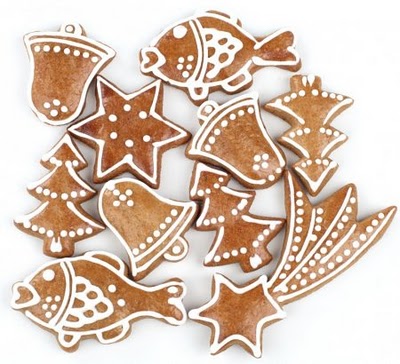
 PERNIK
Pernik (Czech-style gingerbread) has been considered a fancy pastry ever since its beginnings and used to be prepared only for special occasions. Where did pernik come from? No one really knows…some sources point to the ancient Greece and Egypt where it was used as a sacrificial food for various gods. The first pernik was more of a honey-sweetened bread than how it is known today. In the Czech Republic the word “pernik” was first documented in 1335 in the town of Trutnov. The Mid devil pernik recipe called sometimes for more than 90 different types of spices! The most expensive pernik was made with honey – hence the name – the “white” pernik. In the 18th century the bakers were making 4 types of pernik:
- Marcipan
- Pernik
- Cerne sisky (black clumps) – used as a sweetener
- Druberka – was not meant for eating; used as a cheap substitute for children toys
The most famous Czech pernik comes from the Czech town Pardubice – the pernik “headquarters”:)
Ingredience:
- 1 cup sugar
- 41/2 – 5 cups of flour (to make a FIRM dough)
- 2 egg yolks
- 1/2 cup black coffee
- 1 teaspoon cinnamon
- 1/2 teaspoon cloves
- 1/2 cup butter
- 1 cup light molasses
- 1/2 teaspoon ginger
- 1 teaspoon baking soda
Preheat oven to 350 degrees F.
1. Combine all ingredients, adding enough flour to make a dough firm enough to roll out.
2. Turn out on a floured board and roll out to 1/4-inch thickness. Cut with various cutters–a heart, animals, gingerbread men.
3. Place on cookie sheet and bake in a 350 degree oven until firm to the touch, about 15-20 minutes.
4. When cooled, you may decorate pernik using the cake decorator with a butter frosting in various colors.
Source:
http://www.recipelink.com/mf/3/10550
http://yerno.webgarden.cz/historie-perniku
If you liked this post buy me a coffee! (Suggested:$3 a latte $8 for a pound) Thanks!




 Loading ...
How come, that “Pernik” (or “piernik” in Polish) is a “Czech-style ginger bread”, if the world’s capital city of this pastry is Torun, a medieval city of German (Teutonic) origin in the northern part of Poland?:-)
umm, sorry, but “Pernik” (in Polish “piernik”) is rather a pastry of German origin, and it’s world capital city is Torun,a medieval city in the northern Poland, which is also a hometown of Nicholas Kopernik:-)
HI Slawek,
I am not saying that Pernik was originated in Czech, I am just simply stating that it first APPEARED in Czech around 1335, that’s all. I am sure that “all roads lead to Poland”, including the road of Pernik creation:)
Hello Tanja,
You might be right, because even the homepage of the “Kopernik” pastry manufacturer says, that the first notes about “piernik/pernik” in Torun are dated from 1380 – a few dozen of years since 1335
http://www.kopernik.com.pl/index2.php?id=historia&jezyk=2
Maybe not “all roads lead to Poland” but for sure we (CZ and PL) have a lot in common, though we are not aware of this:)
PS: sorry for the double posting, the comment didn’t show up
Hallo Tanja. I was very excited when I found this recipe, but unfortunately made a big mess of it. Can you give me an idea about how much flour to use? My dough went from sticky to inedible without hitting the firm. Thanks very much. Adele
Hi Adele! I am so sorry that your cookies did not work out! I will make the recipe and also ask my friend who gave me that recipe how much flour exactly is she putting in and the I will get back to you, OK?
Thanks very much, Tanja
Hi everybody. Just made a batch. I used 4 1/2 – 5 cups of flour (we are in South) and use honey instead of molasses. It turned out great, just like last year. Merry Christmas. 🙂
Lenko, you saved our lives! THANKS for measuring out the flour!! And sorry Adele, I did not get back to you earlier I totally forgot :((
Now I will put in the new info 🙂
Where can one learn the beautiful and intricate piped icing patterns? There are practically no resources available online, or tutorials in English.
@Rose: No tutorials I’m aware of, but the best way might be to copy and paste “perníčky” into Google image search and take a good look, perhaps print some out. Then prepare your favourite icing (I never measure this, but usually use about two tablespoons of boiling water, juice from one lemon and about 6 tablespoons of icing sugar, all properly mixed together with the back of a spoon in a bowl, as if you’re trying to grind the sugar, until it’s all smooth, creamy and shiny). Transfer the icing to a thin plastic bag, cut off one corner (the hole needs to be fairly small) and then just push the icing out on the cookies, using it as a pen … All that’s left is to practice. You can also use different food colourings for the icing.
I hope it’s more clear than confusing, and surely others here will help with a proper icing recipe (^__^ )
On a second thought – I was wrong: just feed the “perníčky” keyword into YouTube – the very first vid that popped up on me doesn’t require ANY language skills at all.
Where can I get the cookie cuters they use in Czech for the gingerbread cookies?
Thank you
Hi Bernadette,
How about these?
https://www.google.com/search?q=european+cookie+cutters&ie=UTF-8&oe=UTF-8&hl=en&client=safari#q=european%20cookie%20cutters&client=safari&hl=en&source=univ&tbm=shop&tbo=u&sa=X&ei=aHLjUYOeFe_BiwLo4YHQAw&ved=0CC4Qsxg&num=20&sei=a3LjUZW2KofziQLIqoC4Aw&bav=on.2,or.r_cp.&bvm=bv.48705608,d.cGE&fp=ee461bec4b40b0f9&biw=1024&bih=672
I would like to ask you how many pieces of gingerbread do you make from that recipe?
Thank you in advance
Gosh, I don’t remember but I would say about one pan (jeden plech).
Pavlina, I just made a batch and will bake today most likely. I will let you know how much we made. 🙂
Pavlina, so it took a little longer then I thought, we made them today. We make medium size cookies, just like in the picture using cutters from Czech. I have 1.5 kg – makes 156 medium sized cookies and about 70 tiny (about 1 – 2 cm in diameter) cookies. I roll my dough about 0.5 cm.
Also, to make your pernik shinier, brush with egg (whole egg) after you take it out of the oven. You may want to wait just a little so the egg does not crack on your hot pernik.
I also use honey instead of molasses. Good luck and have fun. Marry Christmas.
I am look for a Perino recipe that I can make hard pernik loafs like I remember from home. (Praha) Do you know if I can convert this to it in stead of making cookies?
Thank you so much,
Miša